EN
EN

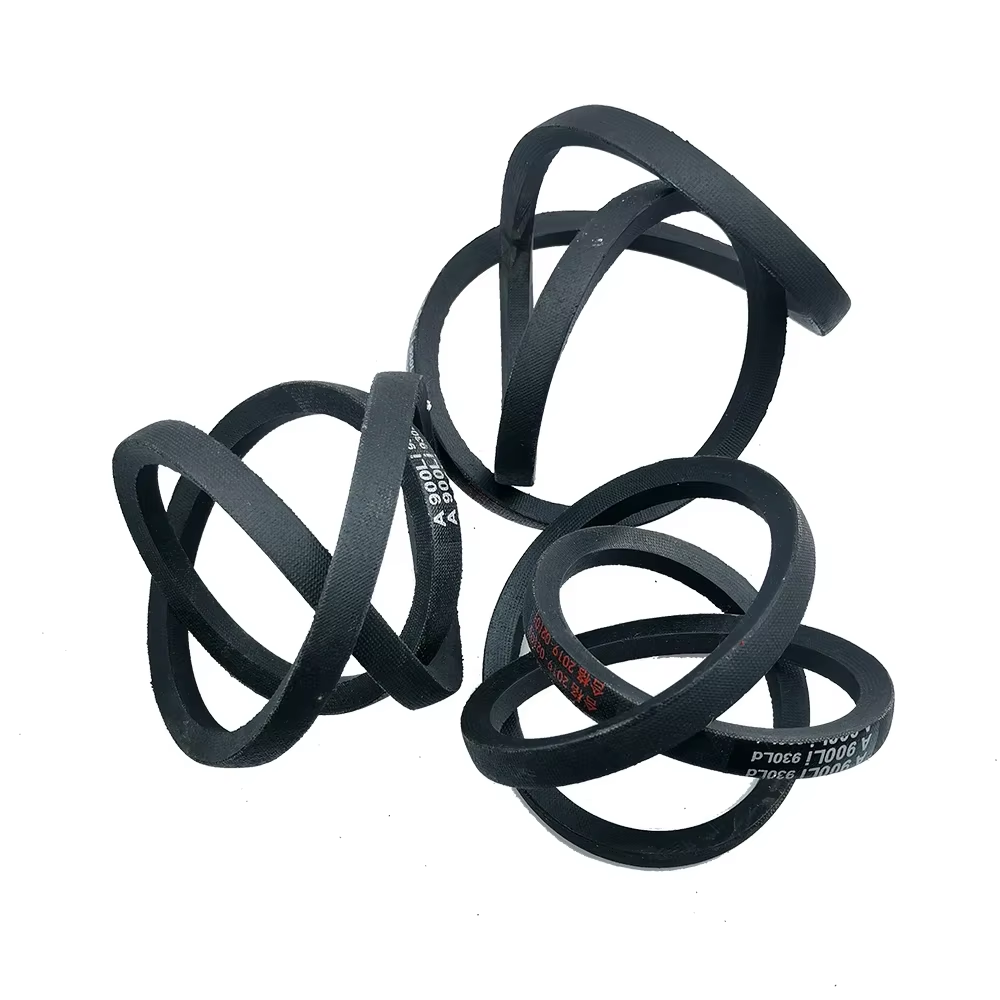
Structural Design: How Wrapped and Cogged V Belts Differ at the Core
Fabric-wrapped outer layer versus raw-edge cogged geometry
The core structural difference between wrapped and cogged V belts lies in their outer construction. A wrapped V belt features a continuous fabric jacket—typically cotton or polyester—that shields the rubber core from abrasion, moisture, and contaminants. This protective layer also minimizes surface wear against sheave grooves, making wrapped belts ideal for dirty or abrasive industrial environments. In contrast, a cogged V belt uses a raw-edge design: its sides are exposed rubber, and its inner surface is cut with precise transverse notches. Eliminating the fabric cover reduces stiffness and friction, enabling significantly greater flexibility—particularly around small-diameter pulleys. The notches further enhance heat management by creating airflow channels during operation. For instance, a cogged belt can bend to a radius approximately 30% smaller than an equivalent wrapped belt while maintaining grip and integrity.
Trapezoidal profile integrity vs. lateral notching for enhanced flexibility
Maintaining a precise trapezoidal cross-section is essential for effective wedging into sheave grooves and reliable torque transmission. Wrapped belts preserve this geometry rigidly—the fabric jacket resists lateral deformation, ensuring consistent contact pressure and tension stability under high loads. However, that rigidity increases bending resistance, contributing to hysteresis losses and internal heat generation. Cogged belts intentionally sacrifice geometric rigidity through lateral notching, which acts like a series of micro-hinges. This allows the belt to conform smoothly to short-radius pulleys without overstressing the tensile cords. The resulting reduction in bending energy loss typically improves drive efficiency by 3–5% over wrapped designs. Engineers select based on priority: wrapped belts when profile fidelity and environmental protection are critical; cogged belts when space constraints, high speed, or thermal management dictate superior flexibility.
Performance Comparison: Flexibility, Heat Management, and Efficiency
Bending resistance and hysteresis loss reduction in cogged v belts
Cogged V belts substantially lower bending resistance due to their notched geometry and absence of a stiffening fabric layer. This enables smoother flexing around compact sheaves and reduces internal friction—directly cutting hysteresis losses. As a result, power transmission efficiency commonly improves by 2–5% compared to equivalent wrapped belts, especially in high-speed systems where even marginal gains reduce long-term energy costs. The raw-edge construction also limits localized rubber deformation, further suppressing heat generation. That cooler operation helps maintain tension stability and extends service life—making cogged belts especially well-suited for drives with frequent starts, stops, or reverse bending.
Thermal performance: up to 22°C lower surface temperature at 5000 rpm
Heat remains a leading cause of V belt failure. Independent lab testing confirms that, at 5000 rpm, a cogged V belt’s surface temperature stays up to 22°C cooler than a comparable wrapped belt. This thermal advantage stems from two key features: the notched profile promotes convective airflow along the belt’s inner surface, and the elimination of the insulating fabric layer improves heat dissipation from the rubber matrix. Cooler operation slows oxidative degradation of elastomers, delays cracking, and preserves tensile cord strength. In continuous-duty applications—especially in thermally constrained enclosures—this performance directly translates to longer belt life and fewer unplanned shutdowns. It also supports dimensional stability under load, reducing secondary wear on sheaves.
Power Transmission & Real-World Suitability for Different V Belt Applications
Cogged v belts excel on small sheaves (<3 in) and high-speed drives
Cogged V belts are the preferred choice for compact, high-RPM applications—particularly where sheave diameters fall below 3 inches. Their reduced bending resistance and notch-enabled flexibility allow efficient power transfer without excessive heat buildup or cord fatigue. Variable-speed drives benefit notably: the belt’s responsiveness to rapid tension shifts supports precise speed control while sustaining torque. Mechanical engineering studies indicate cogged belts maintain up to 98% transmission efficiency in high-speed applications exceeding 5000 rpm—making them standard in centrifugal pumps, textile machinery, and other space-limited, high-performance systems.
Wrapped v belts offer superior damping for pulsating or shock-loaded systems
The fabric-wrapped outer layer provides exceptional vibration absorption and impact energy dispersion—critical in applications subject to sudden torque spikes or irregular loading. Wrapped belts excel in piston pumps, rock crushers, and agricultural equipment, where the continuous jacket distributes shock across the full belt width, protecting shafts, bearings, and sheaves. In pulsating or start-stop duty cycles—such as conveyors and reciprocating compressors—their trapezoidal profile integrity ensures stable tension and consistent wedging, minimizing slippage and wear. Field data shows wrapped belts deliver up to 40% longer service life than cogged alternatives in these shock-loaded environments, where operational reliability outweighs flexibility requirements.
Operational Considerations: Interchangeability, Service Life, and Maintenance
Sheave compatibility and misalignment tolerance differences
Wrapped and cogged V belts share standardized nominal cross-sections and are generally interchangeable on conventional sheaves—but subtle mechanical differences affect real-world fit and performance. The fabric jacket adds slight thickness to wrapped belts, potentially causing binding in worn, undersized, or precision-ground grooves. Cogged belts, with their inherent flexibility, tolerate minor angular misalignment more readily and exhibit less edge wear under imperfect alignment. However, using a cogged belt on a sheave with sharp flange radii may concentrate stress at notch roots, accelerating crack initiation. Always verify groove profile compliance before substitution to ensure safe, long-term operation.
Service life trends: HVAC (wrapped) vs. intermittent industrial (cogged)
Service life depends heavily on operating context—not just belt type. Wrapped V belts dominate HVAC applications because their smooth, dust-resistant surface and vibration-damping fabric-rubber composite perform reliably under steady, clean loads—typically delivering 2–3 years of uninterrupted service. Cogged belts prevail in intermittent industrial settings—like punch presses and indexing conveyors—where frequent cycling generates less cumulative heat but demands resilience to flex fatigue. Their thermal efficiency (up to 22°C cooler surface temperature) and notch-assisted flexibility extend replacement intervals by roughly 30% compared to wrapped belts under identical stop-start conditions.
| Application | Preferred belt type | Key life‑extending factor |
|---|---|---|
| HVAC (steady, clean) | Wrapped | Dust resistance, vibration damping |
| Intermittent industrial (frequent start‑stop) | Cogged | Lower operating temperature, flexibility |
FAQ
What are the main structural differences between wrapped and cogged V belts?
Wrapped V belts feature a fabric jacket for protection against abrasion and contaminants, while cogged V belts have exposed rubber sides and notched inner surfaces for enhanced flexibility and heat management.
Which type of V belt is best for high-speed applications?
Cogged V belts are ideal for high-speed applications due to their reduced bending resistance and improved power transfer efficiency.
Why are wrapped V belts preferred in dirty or abrasive environments?
The continuous fabric jacket of wrapped V belts shields the rubber core and provides abrasion resistance, making them suitable for such conditions.
How do cogged V belts maintain a cooler surface temperature?
Cogged V belts utilize notches that promote airflow and eliminate the insulating fabric layer, enhancing heat dissipation and reducing surface temperature.
Can wrapped and cogged V belts be used interchangeably?
They can generally be used interchangeably, but mechanical differences like thickness and groove compatibility should be verified for optimal performance.
Table of Contents
- Structural Design: How Wrapped and Cogged V Belts Differ at the Core
- Performance Comparison: Flexibility, Heat Management, and Efficiency
- Power Transmission & Real-World Suitability for Different V Belt Applications
- Operational Considerations: Interchangeability, Service Life, and Maintenance
-
FAQ
- What are the main structural differences between wrapped and cogged V belts?
- Which type of V belt is best for high-speed applications?
- Why are wrapped V belts preferred in dirty or abrasive environments?
- How do cogged V belts maintain a cooler surface temperature?
- Can wrapped and cogged V belts be used interchangeably?