EN
EN

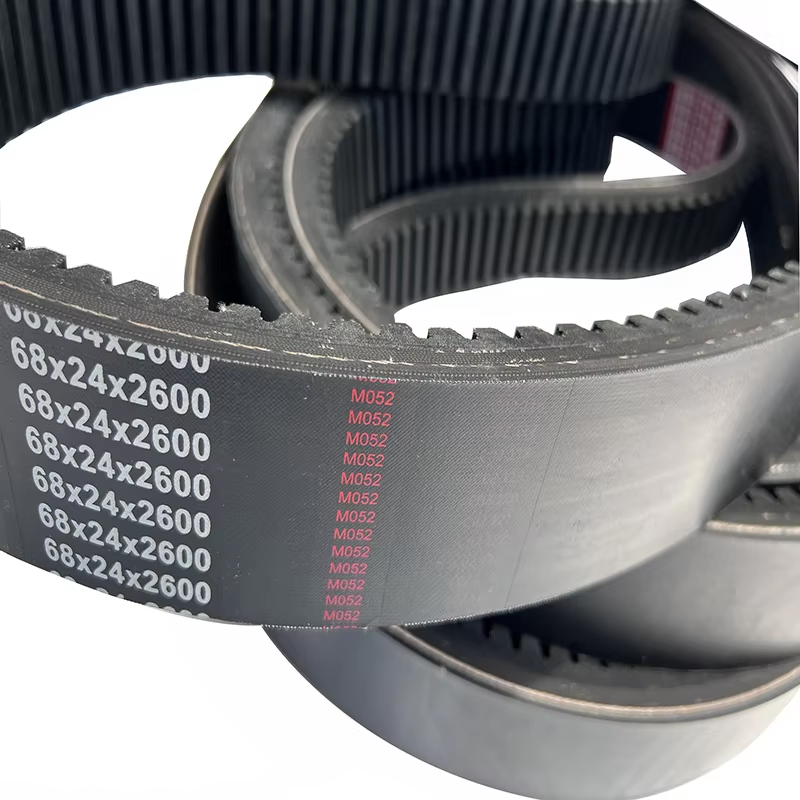
Positive Engagement Mechanism and Elimination of Slippage
Understanding the positive engagement mechanism in synchronous belts
Synchronous belts work by transferring power via those little teeth that fit right into the grooves of their corresponding sprockets. These aren't your typical V-belts that rely on friction to move things along. Instead, they create actual physical contact points between the belt and sprocket, which keeps everything aligned at a consistent angle throughout operation. The result? Positioning accuracy down to less than one degree, something that's really important when working with machines that need pinpoint control. That's why these belts show up so much in CNC equipment where even the slightest misalignment can cause major problems. According to recent findings from the Machinery Efficiency Journal published last year, this kind of precision makes all the difference in manufacturing settings where tolerances are tight and quality matters most.
How toothed belt meshing with sprocket ensures accurate transmission
Tooth profiles distribute shear forces across multiple reinforcing cords, reducing localized deformation. Leading manufacturers optimize helix angles to maintain synchronization at speeds exceeding 7,000 RPM. Properly tensioned systems exhibit less than 0.05% velocity variation—significantly outperforming chain drives, which typically experience 2–5% slippage losses.
Elimination of slippage through mechanical interlocking
The tooth-sprocket interface eliminates creep by:
- Radial force resistance — Teeth withstand 40–60% higher radial loads than trapezoidal V-belt profiles
-
Tangential force management — Distributed loading reduces specific pressure by 73% compared to wrapped belt designs
Field tests show 99.5% torque transmission efficiency in industrial robotics, versus 88–92% for wrapped belts.
Comparison of transmission accuracy between synchronous and V-belts
| Performance Metric | Synchronous Belts | V-Belts |
|---|---|---|
| Angular Positioning Error | <0.15° | 2–5° |
| Speed Variability | 0.03–0.12% | 1.8–4.1% |
| Torque Transmission | 98–99.5% | 85–93% |
| According to the Drivetrain Optimization Report 2023, these performance advantages explain why synchronous belts dominate precision motion control systems requiring cumulative position errors under 0.5° per 10,000 cycles. |
Core Construction Features That Enable Dimensional Stability
Role of Reinforced Tensile Cords in Maintaining Belt Geometry Under Load
The dimensional stability we see in synchronous belts comes mainly from those high modulus tensile cords running through them. Most often these are made of either fiberglass or aramid fibers and embedded throughout the belt's entire length. What makes these cords so important? They basically serve as the belt's backbone, stopping it from stretching out when loads are applied. Some independent tests have actually measured how effective this reinforcement is. The results? About an 89 percent reduction in longitudinal stretch compared with belts that don't have any reinforcement at all. This matters because maintaining consistent tooth spacing becomes critical when transmitting peak torque across machinery components.
Material Selection for Low Elongation and High Fatigue Resistance
Thermoset rubber compounds and polyurethane blends with elongation below 0.5% at 10% of breaking strength are preferred for their molecular rigidity and elastic recovery. A 2023 polymer fatigue study found specialized urethane formulations improve cyclic load retention by 3.7— over standard rubber, ensuring long-term profile integrity across millions of flex cycles.
Influence of Backing Layer on Wear Resistance and Operational Noise
The backing layer made from precision ground nylon or polyester reinforcement cuts down on those annoying harmonic vibrations anywhere between 12 to maybe even 18 decibels when compared against regular textured surfaces. What this smooth surface does is actually reduce the heat generated by friction while standing up better to wear caused by constant contact with sprockets during operation. When paired with our tensile cord system, we're talking about maintaining pretty impressive pitch accuracy around 0.03 millimeters per meter even when things get bumpy under load conditions. And let's face it, this kind of stability matters a lot for keeping multiple axes working together properly in complex machinery setups.
Tooth Profile Design: Trapezoidal vs Curvilinear for Precision Meshing
Overview of Common Synchronous Belt Tooth Profiles (HTD, STD, RPP)
The performance of synchronous belts depends heavily on their tooth design when it comes to transferring power accurately. Three main types dominate the market these days: HTD stands for High Torque Drive, STD is Standard Trapezoidal, and there's also RPP which means Round Precision Profile. The HTD belts feature curved teeth that help reduce stress points during operation. For those looking at budget options, STD belts have that classic trapezoidal shape that gets the job done without breaking the bank. Then we get to RPP belts, which are something special really. They combine rounded curves with carefully spaced teeth making them ideal for situations where noise needs to stay minimal and precision down to fractions of a millimeter matters a lot.
Trapezoidal vs Curvilinear Tooth Design: Efficiency, Load Sharing, and Stress Distribution
The trapezoidal profile tends to gather around 60 to 70 percent of all the operational stress right at the base of each tooth, which is why these types generally aren't suitable for applications running above 1,500 RPM according to what was published in Mechanical Drive Systems back in 2023. On the flip side, when we look at curvilinear designs, they actually spread out those forces over the whole surface area of the tooth thanks to their rounded shape. This design change allows them to handle about 15 to maybe even 20 percent more torque while also experiencing less wear and tear over time. The real difference becomes apparent when looking at transmission efficiency numbers. At speeds reaching 3,000 RPM, curvilinear belts maintain better than 98 percent efficiency, whereas traditional trapezoidal belts only manage between 92 and 94 percent efficiency under similar conditions.
Impact of Tooth Shape on Meshing Accuracy and Long-Term Reliability
Precision-ground curvilinear teeth exhibit 40% lower angular deviation (±0.05°) during meshing than trapezoidal profiles in CNC validation tests. Their smooth engagement reduces shock loads, extending belt life by 30–50% in continuous-duty applications. However, trapezoidal designs offer slightly tighter backlash (0.02–0.03 mm), benefiting ultra-precise systems requiring micron-level repeatability.
Case Study: Performance Differences in Industrial Automation Systems
A leading packaging machinery manufacturer reduced maintenance intervals by 72% after upgrading from trapezoidal to modified curvilinear belts in high-speed filling lines. The new design maintained positional accuracy within ±0.1 mm while operating at 120 cycles per second, demonstrating how tooth geometry directly enhances performance in dynamic environments.
Belt-Sprocket Compatibility and System-Level Alignment Accuracy
Importance of matching belt and sprocket profiles for precise synchronization
Accurate timing depends on perfect compatibility between belt and sprocket tooth geometry. Mismatched profiles cause uneven loading, accelerating wear in 78% of cases (Industrial Power Transmission Journal, 2022). Pairing precision-ground sprockets with belts conforming to ISO 13050 curvature standards prevents angular errors exceeding 0.25° in packaging equipment.
Effect of manufacturing tolerances on drive system performance
High-end systems with tight tolerances (±0.02 mm) limit speed variation to <0.5% across temperature ranges. However, cumulative errors from belt pitch inaccuracies, sprocket concentricity deviations, and shaft misalignment can degrade positional repeatability by up to 60% in robotic arms. Modern metrology tools identify dimensional outliers before assembly, improving first-pass yield rates by 29%.
Impact of sprocket wear on transmission precision and belt lifespan
Worn sprocket teeth increase polyurethane belt wear by 3.2— under nominal conditions, based on CNC lathe maintenance data. Progressive tooth tip rounding beyond 0.15 mm clearance introduces backlash errors exceeding ±0.8° in rotary indexers. Implementing preventive replacement guided by laser-measured flank wear preserves velocity stability within 0.1% over 15,000 operating hours.
Trend: Use of laser alignment systems in preventive maintenance
Modern laser alignment tools can hit around 0.01 mm accuracy when it comes to positioning, which is roughly 50 times better than what old school straightedge techniques could manage. The technology behind these systems allows them to spot issues like angular misalignment down to about 0.005 radians, catch parallel offsets under 0.2 mm, and even monitor tension problems throughout complex drive setups. According to Markets and Markets data from 2023, nearly a quarter of all new industrial drives come equipped with built-in sensors. These sensors let manufacturers keep tabs on synchronization in real time, something that has cut unexpected downtime by almost half in many automotive factories. For plant managers dealing with tight production schedules, this kind of precision makes a world of difference.
Achieving Timing, Speed, and Torque Accuracy in Real-World Applications
Maintaining Constant Velocity Ratio for High-Precision Motion Control
Positive engagement between teeth and sprockets allows synchronous belts to maintain velocity ratios within 0.01% deviation under dynamic loads (ASME 2023). This mechanical lock prevents the cumulative positioning errors typical of friction-dependent systems. For instance, servo-driven packaging machines using HTD belts achieve ±0.05 mm repeatability during high-speed label application.
Data Point: Sub-0.1° Angular Error in CNC Indexing Tables Using HTD Belts
A 2024 ISA study of vertical machining centers found that trapezoidal-tooth synchronous belts reduced rotary table angular errors to 0.08° at 900 RPM. Chain-driven equivalents showed 0.35° deviation due to chordal action, highlighting the superiority of belt drives in maintaining tight tolerances during complex contouring operations.
Managing Torque Transmission Efficiency and Hysteresis Losses at High Speeds
Synchronous belts sustain 98–99% torque efficiency up to 2,000 RPM, with hysteresis losses limited to <1.5% of transmitted power thanks to advanced polyurethane compounds (Rubber World 2023). At 15 N·m loads, phase lag remains under 0.3° during rapid acceleration—critical for robotic stations requiring millisecond-level coordination.
Strategy: Minimizing Inertia Mismatches in Servo-Driven Synchronous Systems
To prevent oscillation during directional changes, servo-driven synchronous systems should maintain an inertia ratio of 3:1 between motor rotors and driven components. Per ISA-95 industrial automation guidelines, integrating low-backlash tensioners and torque-limiting couplings helps absorb peak inertial forces without sacrificing positional accuracy.
FAQ
What is the primary advantage of synchronous belts over V-belts?
Synchronous belts offer superior positioning accuracy, typically less than 0.15°, compared to the 2–5° error commonly seen in V-belts. This makes them essential for precision applications where cumulative errors must be minimized.
How do synchronous belts minimize slippage?
Synchronous belts minimize slippage by utilizing teeth that mesh perfectly with the sprocket. This mechanical interlocking ensures efficient transmission of torque and maintains a consistent speed ratio.
Why are curvilinear tooth designs more efficient at high speeds?
Curvilinear tooth designs distribute operational forces across the entire tooth surface, reducing location-specific stress and enabling them to handle higher torque and speed with better efficiency than traditional trapezoidal teeth.
How does the backing layer improve belt performance?
The backing layer, typically made from nylon or polyester, decreases operational noise and reduces wear, thereby enhancing the belt's durability and maintaining pitch accuracy under load.
What role do tensile cords play in synchronous belts?
Tensile cords provide the belt with structural support, preventing it from stretching and maintaining dimensional stability, which is crucial for ensuring consistent tooth spacing when transmitting peak torque.
Table of Contents
- Positive Engagement Mechanism and Elimination of Slippage
- Core Construction Features That Enable Dimensional Stability
- Tooth Profile Design: Trapezoidal vs Curvilinear for Precision Meshing
- Belt-Sprocket Compatibility and System-Level Alignment Accuracy
- Achieving Timing, Speed, and Torque Accuracy in Real-World Applications
- FAQ