EN
EN

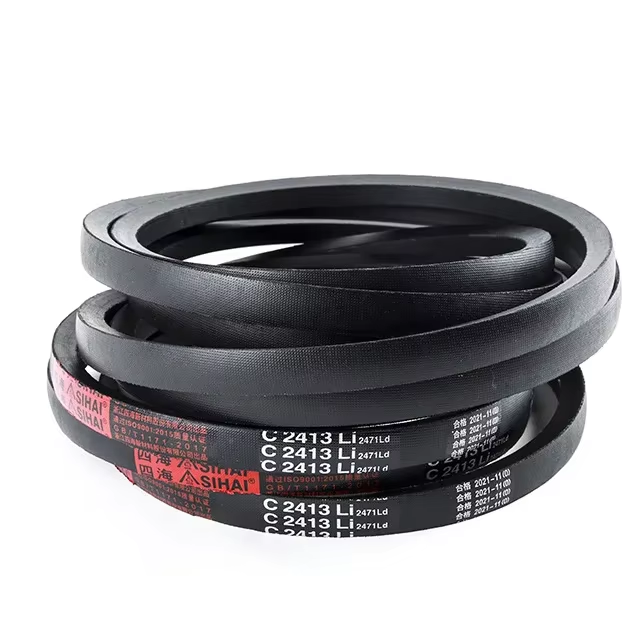
Cost-Effectiveness Compared to Alternative Drive Systems
Lower initial investment and operational costs of v belt systems
V-belt systems require 60–75% lower upfront costs than chain or gear drives, with installation averaging 40% less due to simpler mechanical requirements. Unlike hydraulic systems, which demand pumps, valves, and fluid management, v belts operate without auxiliary components—making them the preferred choice in 83% of medium-power industrial applications (Power Transmission Journal 2023).
Long-term savings from decreased wear and replacement frequency
Annual maintenance for v belts averages under $0.15 per operating hour, significantly below the $0.30–$0.50 range for gear drives. The trapezoidal cross-section evenly distributes stress, reducing premature failures by 62% in continuous-use settings like conveyor systems, translating into fewer replacements and extended service intervals.
Industry paradox: High performance despite low-cost materials
Despite being made from cost-effective rubber-fabric composites, v belts achieve 94–98% power transmission efficiency through optimized wedge angles. This performance matches that of more expensive synchronous belts while using materials costing 35% less, challenging the notion that high efficiency requires premium polymers or metal-based designs.
Durability and Performance in Harsh Industrial Environments
Resistance to heat, oil, and dust exposure
V belts remain stable at temperatures up to 212°F (100°C) and absorb 68% less oil than flat belts (Rubber Technology International 2023). Belts made with ethylene propylene diene monomer (EPDM) resist hardening and cracking even in environments with particulate levels exceeding 15 mg/m³, ensuring reliable operation in dirty or oily conditions.
Reliable operation under high torque and heavy loads
Trapezoidal profiles create five distinct contact points on the pulley surface, which means some heavy duty industrial versions can handle as much as six and a half times their normal torque capacity before breaking down. According to field reports from mining sites in 2024, V-belts actually performed better than traditional chain drives when it comes to absorbing sudden shocks at speeds over 1,500 RPM. The difference was pretty significant too - around three times better shock absorption capability. This makes them particularly valuable equipment for applications where loads constantly change direction or intensity throughout operation.
Case study: V-belt durability in agricultural machinery under extreme conditions
The Agricultural Machinery Institute tested standard AX-78 v belts in combine harvesters operating at 104°F (40°C) with 90% dust saturation. After 5,000 service hours:
| Metric | V-Belt Retention | ISO 4183 Standard |
|---|---|---|
| Tensile strength | 92% | ≥80% |
| Width stability | 98% | ≥90% |
| Deformation resistance | 100% | No failure |
Results show v belts not only meet but exceed international durability benchmarks under real-world stress.
Trend: Advanced rubber compounds extending v belt service life
Carbon nanotubes are now integrated into belt cores, reducing heat-induced expansion by 40% compared to traditional polyester cords. In metalworking plants, this advancement has extended mean time between replacements (MTBR) to 18–24 months—a 300% improvement over 2018 levels—reducing lifecycle costs and unplanned downtime.
Low Maintenance and Operational Simplicity
No Lubrication Required and Minimal Downtime
Unlike chain or gear drives, v belts require no lubrication, eliminating a routine maintenance task and avoiding contamination risks in sensitive sectors such as food processing. This design reduces scheduled downtime by 18–24 hours annually per machine (Maintenance Engineering Journal 2023), while maintaining consistent power transfer over long periods.
Easy Installation and Removal Reduce Labor Costs
The tapered profile allows tool-free tension adjustments and fast replacements. Field data indicates maintenance teams complete swaps 40% faster than with synchronous belts, saving $120–$180 per incident in labor costs. Their adaptability also simplifies retrofits, enabling direct replacement of complex drive systems without frame modifications.
Predictive Maintenance Enabled by Consistent V-Belt Performance
Premium v belts exhibit gradual, predictable wear, allowing accurate lifespan forecasting. In facilities using wear monitoring sensors, 85% report unplanned downtime rates below 2%. Because modern compounds maintain tension integrity until the final 15% of service life, operators can schedule replacements during planned outages, minimizing production disruptions.
Wide Versatility Across Industrial Applications
Common uses in manufacturing, agriculture, and HVAC systems
V belts show up everywhere from factories to farms. Manufacturers depend on them to power conveyor belts and keep production lines running smoothly, especially when dealing with heavy loads where a firm grip matters most. Farmers know this too, since their combines and tractors need belts that can handle all sorts of dirt and debris without breaking down. Then there's HVAC equipment where quiet operation becomes important. Air handlers and those big centrifugal fans work better with V belts because they don't make as much noise and actually last longer through temperature changes compared to metal options. Many technicians will tell anyone who asks that these rubber belts just perform better in real world conditions than their metallic counterparts ever could.
Available in diverse sizes for custom mechanical configurations
With standard widths from 0.3" to 1.5", v belts support torque loads ranging from 15–800 N·m. Specialized wedge profiles ensure traction on pulleys as small as 2" in diameter, giving engineers flexibility to design compact drives for packaging equipment or robust setups for mineral processing—all without custom tooling.
Why v belts remain universally adopted despite newer technologies
Despite all the new synchronous and direct drive systems coming onto the market these days, most industrial maintenance crews still stock up on V belts as their go to spare parts. The reason? These belts are mechanically simple stuff that works across different industries. A single type can actually fit everything from mixers to compressors and even pumps without much trouble. And let's face it, they're easy to check for wear too. With those visible signs of wear showing up right there on the belt itself, plus how straightforward inspections tend to be, no wonder they remain so popular whether in older factories or newer automated setups where things get complicated fast.
Frequently Asked Questions
Why are V-belt systems more cost-effective than alternatives?
V-belt systems have lower upfront and operational costs compared to chain or gear drives, due to simpler mechanical requirements and lack of auxiliary components.
How often do V-belts need replacement or maintenance?
V-belts are designed for long-term savings, requiring less frequent maintenance and replacements, with an average maintenance cost under $0.15 per operating hour.
What makes V-belts suitable for harsh environments?
V-belts resist heat, oil, and dust, ensuring reliable performance in harsh industrial conditions.
What industries commonly use V-belts?
V-belts are widely used in manufacturing, agriculture, and HVAC systems due to their versatility and reliability.