EN
EN

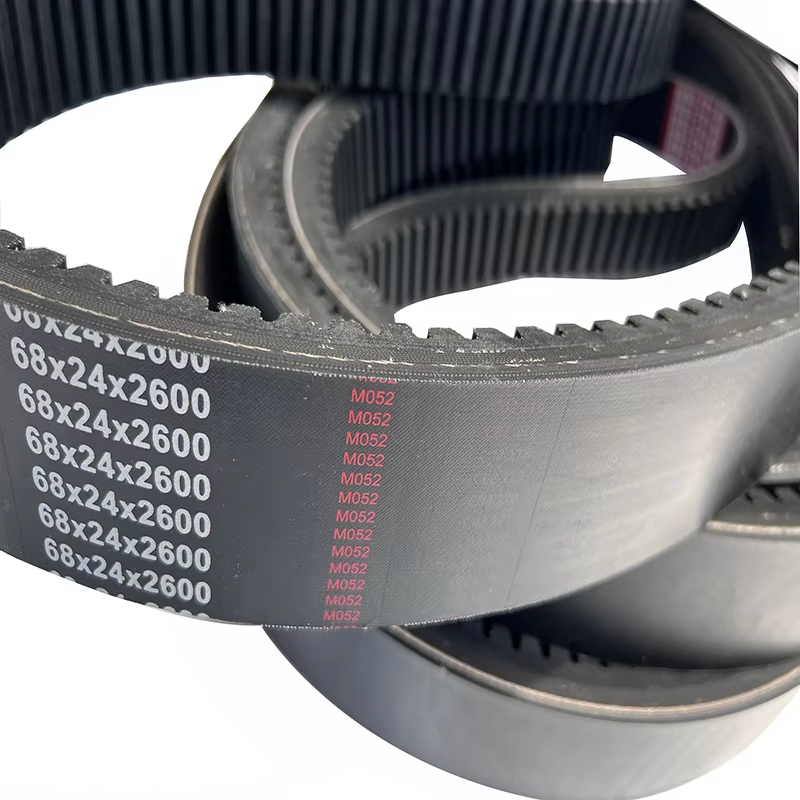
Higher Load Capacity and Power Transmission Efficiency
How Wedge Action and Advanced Tensile Cords Reduce Slippage Under High Torque
High-strength V belts use mechanical wedge action to maximize surface contact with pulleys—reducing slippage and energy loss even under extreme torque. Aramid tensile cords deliver three times the load-bearing capacity of traditional polyester while maintaining dimensional stability at high speeds. Together, these features enable up to 98% power transmission efficiency, as confirmed by industry-standard belt performance benchmarks.
Real-World Gains: 32% Efficiency Improvement in Conveyor Drives with Kevlar-Reinforced V Belts
A 2024 material handling report documented a 32% improvement in drive efficiency across mining conveyor systems after switching to Kevlar-reinforced V belts. This gain stems from a 19% reduction in belt stretch under load, 28% less heat generation during peak operation, and elimination of sudden tension failures. Over 47,000 operating hours across 14 facilities, maintenance logs showed 63% fewer belt replacements versus standard models—directly lowering energy consumption per output ton.
Exceptional Durability in Harsh Industrial Environments
EPDM and Neoprene Composites Resist Ozone, Oil, Heat, and Abrasion
Industrial V belts face relentless stressors: ozone, oils, extreme temperatures, abrasives, and steam. Advanced elastomer formulations counter each threat precisely. Ethylene Propylene Diene Monomer (EPDM) offers innate resistance to ozone and steam—making it ideal for food processing and sterilization environments. Neoprene composites resist industrial oils and lubricants while retaining flexibility down to –40°C. Both incorporate carbon black reinforcement to withstand abrasion from coal dust, metal shavings, and mineral particulates. Accelerated aging tests show this engineered resilience extends service life by up to 40% in cement plants and foundries compared to standard rubber belts—cutting unplanned downtime and maintenance costs where failure halts production.
Longer Service Life and Lower Total Cost of Ownership
High-strength V belts extend operational lifespans and reduce total cost of ownership through fewer replacements, less labor, and minimized production interruptions.
2.3× Greater MTBF in Steel Mill Applications vs. Standard V Belts
In steel mill environments, high-strength V belts achieve 2.3 times the Mean Time Between Failures (MTBF) of standard belts, per a 2023 industrial reliability study. This translates to up to 40% fewer unplanned shutdowns and measurable cost savings—facilities report over $50,000 annually per production line in reduced replacement parts and labor.
Predictive Maintenance Enabled by Heat-Resistant V Belt Construction
Heat-resistant construction supports reliable integration with thermal and vibration sensors, enabling accurate wear monitoring under extreme conditions. Early detection of degradation prevents catastrophic failures, cutting downtime by 25% and extending service intervals—further reducing total cost of ownership.
Frequently Asked Questions
What makes high-strength V belts more efficient than standard belts?
High-strength V belts are designed to maximize surface contact with pulleys through mechanical wedge action, which reduces slippage and energy loss. The use of aramid tensile cords enhances load-bearing capacity while maintaining dimensional stability at high speeds.
How do EPDM and Neoprene composites contribute to the durability of V belts?
EPDM offers resistance to ozone and steam, whereas Neoprene resists industrial oils and maintains flexibility at low temperatures. Both materials incorporate carbon black for enhanced abrasion resistance, extending service life in harsh environments.
What are the benefits of predictive maintenance with heat-resistant V belts?
Heat-resistant V belts allow for reliable integration with sensors to monitor wear under extreme conditions. This enables early detection of degradation, preventing catastrophic failures and reducing downtime.