EN
EN

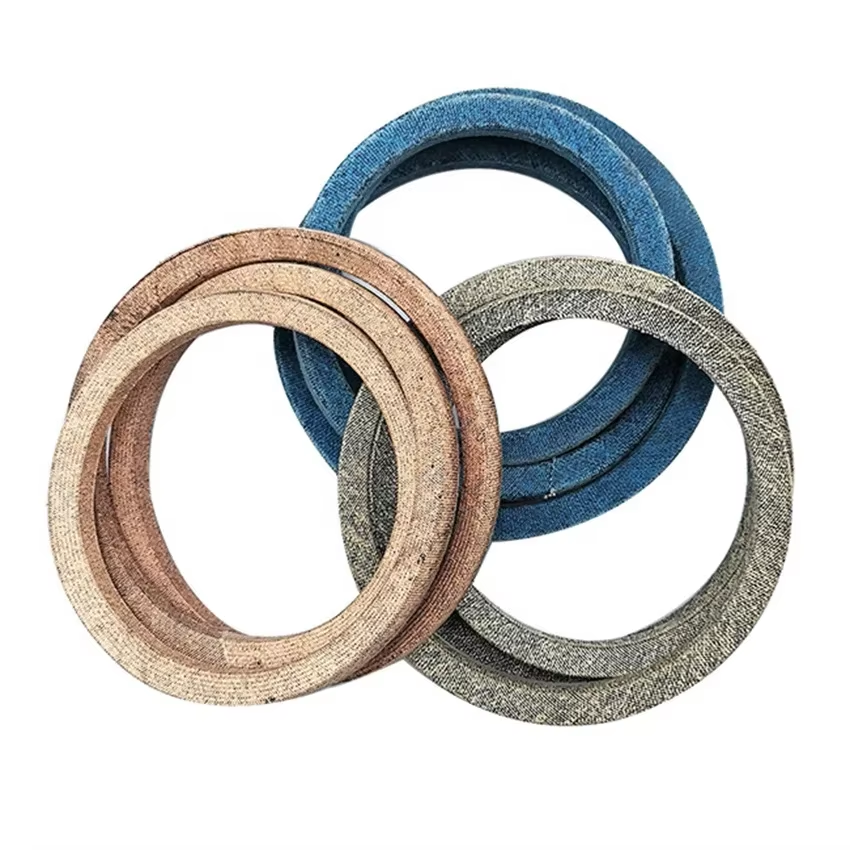
High-Strength Reinforcement: Aramid and Kevlar Cords for Tensile and Flex Fatigue Resistance
How Aramid Fibers Resist Stretching and Micro-Cracking Under Cyclic Load
Aramid fibers resist elongation under tension through tightly aligned, rigid polymer chains that distribute stress uniformly—preventing localized strain and micro-cracking during repeated flexing. This molecular architecture delivers exceptional dimensional stability, limiting belt stretch to under 0.3% at working loads and eliminating slippage or pulley misalignment risks. Per ASTM D430 testing, aramid-reinforced belts show 40% less fatigue degradation than nylon equivalents after 5,000 flex cycles—a direct result of their inherent rigidity and stress-dissipating structure.
Kevlar vs. Polyester Cords: Flex Life Performance Data (ASTM D412/D2240 Benchmarks)
Kevlar cords outperform polyester in both tensile strength and flex endurance. ASTM D412 testing confirms Kevlar’s tensile strength (63,000 psi) is triple that of polyester (21,000 psi), while D2240 durometer results show 30% greater cut resistance. In accelerated flex life testing, Kevlar-reinforced belts survive over 15,000 back-bend cycles—three times longer than polyester-based counterparts. This translates directly to real-world reliability: commercial mowing fleets report 68% fewer belt replacements after 200 operating hours when using Kevlar-reinforced belts.
Heat-Resistant Rubber Compounds and Hybrid Steel-Cord Construction
EPDM vs. HNBR: Thermal Stability and Degradation Thresholds in Lawn Mower Belt Applications
HNBR and EPDM differ fundamentally in thermal resilience due to molecular saturation. HNBR’s hydrogenated backbone resists oxidative cracking far more effectively than EPDM’s unsaturated bonds, enabling sustained operation above 160°C (320°F) with 28% slower crack propagation. While EPDM remains flexible up to 150°C (302°F), its performance degrades rapidly beyond 120°C (248°F) under load. Field validation shows HNBR retains 90% of its original tensile strength after 300 operational hours—versus just 73% for EPDM under identical conditions—making it the preferred compound for high-duty-cycle commercial equipment.
Steel-Cord Hybrid Belts: Field Validation of 37% Lower Failure Rate in Commercial Lawn Mower Belts
Steel-cord hybrid belts combine the tensile strength of steel with the damping properties of rubber to target the leading cause of failure: flex fatigue (responsible for 68% of breakdowns). A two-year, 500-unit field study across commercial operators found these hybrids reduced replacement frequency by 37%. The steel core absorbs shear forces from pulley misalignment and resists compressive deformation—reducing stress on the rubber matrix by 41%. Though specialized bonding is required to ensure cord-rubber adhesion, the resulting average service life of 22 months validates their use in high-demand applications.
Optimized Cogged V-Belt Design for Reduced Friction, Heat Buildup, and Debris Retention
Thermal Imaging Evidence: Cogged vs. Solid V-Belts at Operating RPM (3600 RPM)
Thermal imaging at 3600 RPM demonstrates cogged V-belts run up to 30°F cooler than solid-section designs—a critical advantage in heat-sensitive lawn mower applications. The notched geometry enhances flexibility and airflow, cutting internal hysteresis by 30% and significantly reducing friction-induced heat buildup. Cooler operation slows rubber aging and minimizes debris retention in the groove profile. As a result, cogged belts maintain consistent power transfer and exhibit fewer failures over time—particularly during extended mowing sessions in hot, humid conditions.
Abrasion Resistance Against Real-World Lawn Mower Belt Stressors
Taber Abraser Testing: Quantifying Volume Loss Across Materials After Simulated 200-Hour Mowing
Grass clippings, grit, and misaligned pulleys subject lawn mower belts to continuous abrasive wear. ASTM D4060 Taber Abraser testing simulates 200 operational hours—the equivalent of a full commercial season—to measure material loss. Results highlight stark performance differences:
| Material Type | Avg. Volume Loss (mm³) | Relative Durability |
|---|---|---|
| Standard Rubber | 420 ± 35 | Baseline |
| Polyester-Reinforced | 250 ± 28 | 40% improvement |
| Kevlar-Reinforced | 95 ± 15 | 77% improvement |
Kevlar’s dense, high-modulus fiber structure deflects abrasive particles rather than yielding to them—preserving surface integrity where standard and polyester-reinforced belts develop fissures and pitting. This resistance is especially valuable in challenging environments like overgrown fields or sandy soils, where debris loading is highest.
FAQ Section
What are the benefits of using aramid fibers in belts?
Aramid fibers provide exceptional tensile strength and dimensional stability. They resist elongation and micro-cracking, making them ideal for applications requiring reliable performance under cyclic loading.
How does Kevlar compare to polyester cords?
Kevlar cords exhibit superior tensile strength, flex endurance, and cut resistance compared to polyester cords. They last longer under high-stress conditions, reducing the frequency of belt replacements.
Why is HNBR preferred over EPDM in thermal applications?
HNBR offers better resistance to thermal degradation and oxidative cracking, maintaining tensile strength and stability at higher temperatures compared to EPDM.
What advantages do cogged V-belts provide?
Cogged V-belts reduce friction and heat buildup due to their notched design, enabling cooler operation and extending the life of the belt in heat-sensitive environments.
How does Kevlar improve abrasion resistance in lawn mower belts?
Kevlar’s high-modulus construction deflects abrasive particles, minimizing wear and tear under challenging conditions, thus extending belt durability.
Table of Contents
- High-Strength Reinforcement: Aramid and Kevlar Cords for Tensile and Flex Fatigue Resistance
- Heat-Resistant Rubber Compounds and Hybrid Steel-Cord Construction
- Optimized Cogged V-Belt Design for Reduced Friction, Heat Buildup, and Debris Retention
- Abrasion Resistance Against Real-World Lawn Mower Belt Stressors
- FAQ Section